
Regional Childcare
CUPPAD is currently working with state, regional, and local partners on improving regional childcare capabilities and capacities as it relates to planning and zoning principles and policies.
Childcare isn't just a family issue — it's an economic development issue. A report from the U.S. Chamber of Commerce Foundation, produced in partnership with the Grand Rapids Chamber and Michigan Chamber of Commerce, found that childcare challenges cost Michigan's economy an estimated $2.88 billion annually through employer losses from turnover and absenteeism and lost state tax revenue. Closer to home, a 2024 regional assessment by the Early Childhood Education Task Force of the Upper Peninsula found that in much of the U.P., there are three or more children competing for every licensed childcare spot — and in some areas, no licensed spots at all. Over half of U.P. families surveyed were spending more than double the federally defined threshold for "affordable" childcare, and 75% of U.P. employers reported seeing absences directly tied to childcare challenges. Addressing childcare supply is essential to attracting and retaining the workforce our communities need to grow.
Childcare Planning and Zoning Resources
Childcare Is a Land Use Issue
One of the most direct levers local governments have to address the childcare shortage is land use planning. Outdated or overly restrictive zoning can quietly prevent childcare businesses from opening — even when the community desperately needs them. The U.P. ECE Task Force's municipal assessment found that a significant number of local master plans across the region are out of date, and that strategies addressing childcare are uncommon in U.P. plans. That's an opportunity.
Why it matters:
Access to childcare is inextricably linked with housing, transportation, and employment needs. Lack of access and unaffordable childcare may lead to a parent dropping out of the workforce, while access to convenient, affordable childcare can create economic advantages for both families and communities. Treating childcare centers as commercial land uses rather than neighborhood-serving uses increases the cost and inconvenience of childcare for residents — and increased zoning barriers add directly to the cost of care.
Good planning and zoning practices for childcare include:
- Allow childcare by right in more zones. The American Planning Association encourages communities to amend local zoning ordinances to remove obstacles to regulated group and family childcare in all appropriate and safe zoning districts — rather than requiring a special use permit or public hearing for every application.
- Simplify the permit process. Where conditional use permits are required, make them administrative (staff-level review, no public hearing) for smaller or lower-impact facilities. Lengthy, expensive approval processes disproportionately burden small, home-based providers who have the least capacity to absorb delays.
- Reduce or waive fees. Permit and impact fees designed for commercial development can be prohibitive for childcare entrepreneurs operating on thin margins. Many communities have begun waiving or reducing fees for childcare facilities the same way they do for affordable housing.
- Include childcare in your master plan. Long-range comprehensive plans set the framework for regulatory and programmatic change — evaluating these plans for areas that need more policy support for childcare facilities is an important first step. Communities that explicitly address childcare needs in their master plans create a foundation for the zoning and programmatic changes that follow.
- Consider adaptive reuse. Vacant commercial spaces, underused schools, and church buildings are often well-suited for childcare facilities. Zoning and local incentives can encourage their conversion.
- Account for rural realities. In the U.P., older building stock, private well and septic systems, and long distances to inspection resources create unique barriers. Municipalities can help by streamlining local permitting steps that are within their control and actively connecting aspiring providers with state and regional navigation support.
Best Practices and Resources for planners and local officials
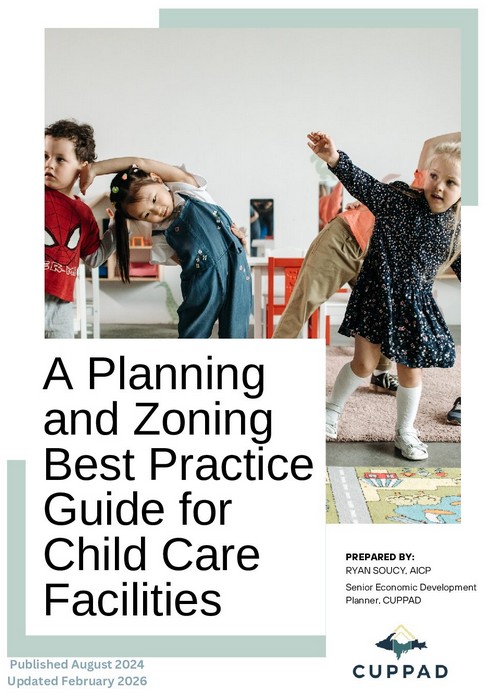
A Planning and Zoning Best Practice Guide for Child Care Facilities
Updated: February 2026
Released: August 2024
Prepared in association with regional partners as part of funding provided by the Upper Peninsula Michigan Works as a Grantee of the Childcare Regional Planning Grant awarded by the Early Childhood Investment Corporation under its Innovation Fund; this funding is made available through the Caring for MI Future grant awarded to the Michigan Department of Education-Office of Great Start (MDE-OGS) through the federal American Recovery Plan Act (ARPA).
This guide is intended to guide and inform local decision makers and planning commissioners as it pertains to local zoning policies. It draws from state and national legislation to streamline definitions and actions that can help local municipalities to address childcare issues.
OTHER RESOURCES
- Childcare Memorandum to Central UP Planning Commissions
- Central UP Childcare Audit Results
- APA Policy Guide on the Provision of Child Care — the American Planning Association's longstanding policy guidance on integrating childcare into local planning and zoning
- Reducing Barriers for Childcare Facilities, Parts 1 & 2 — a two-part series from MRSC (Municipal Research and Services Center) with practical examples of how communities are updating their codes to support childcare development
- Michigan Child Care Mapping Project — Child Care Deserts Map — use this to illustrate the need in your community when making the case for plan updates
Starting a childcare business
Michigan needs more licensed childcare providers. The good news is that there are more resources than ever to help aspiring providers get started. The State of Michigan recognizes three types of licensed childcare facilities:
- Family Child Care Home — care for 1–6 unrelated children in your home
- Group Child Care Home — care for 7–12 unrelated children in your home
- Child Care Center — care in a commercial facility for any number of children under 13
Step-by-step guidance and licensing resources:
- Step-by-Step Guide to Child Care Licensure in Michigan — a plain-language walkthrough of the full licensure process, from application and zoning approval through orientation, inspection, and your original license
- Michigan Child Care Licensing Bureau (MiLEAP) — the official home for licensing rules, laws and regulations, applications and renewals, the CCHIRP provider portal, and parent and provider resources from the state agency that oversees all licensed childcare in Michigan
- Our Strong Start (OSS) Program — a MiLEAP initiative specifically designed to support new providers entering the field, with coaching and resources to help navigate the licensing process
- Great Start to Quality — Michigan's quality rating and improvement system for childcare providers; includes a searchable directory of licensed providers and quality improvement resources
- Great Start to Quality U.P. Resource Center — local support for providers in the Upper Peninsula, including help connecting families to available care (call 906.228.3362)
Financial supports for providers:
- Child Development and Care (CDC) Scholarship — state subsidy that covers the cost of care for income-eligible families; providers who accept CDC scholarships expand their customer base while supporting working families. Learn more at michigan.gov/mileap
- Child and Adult Care Food Program (CACFP) — federal food subsidy available to licensed childcare providers; helps offset operating costs while improving nutrition for children in care. Learn more at michigan.gov/mde/cacfp
- MI Tri-Share — providers enrolled in MI Tri-Share receive consistent, direct payment through the regional hub, reducing billing burden. See above for details.
Other Resources
CUPPAD is a partner in the UP Regional Child Care Coalition. We can connect you with local resources, technical assistance, and programs that support employers, childcare entrepreneurs, and communities working to improve childcare access.
Updated 4/13/26